
IF EVER YOU ARE required by some terrifying authority to provide a definition, with examples, illustrating the essential difference between parody and pastiche, then you can do a lot worse than visit the Rolling Stones’ back catalogue. Parodies and pastiche litter their canon, collecting in drifts, cool and papery to the touch like discarded lizard skins, edible like seaweed (flash-fry them in garlic and oil) and nutritious, as all forms of literary apparatus are nutritious — except that you do have to pick a lot of bones out.
The Stones are complicated. No, I’m afraid they are. Those lovers of song who prefer their music to be identified for them with due provenance and endorsed in triplicate with an academy-certified “validité de la purité secondaire” confirming the authenticity of whatever source material Dartford’s finest have pilfered from this time … well, such folk tend historically to have problems with the Stones anyway because their music is and always was fundamentally not pure; furthermore, they have seldom been troubled to try and hide that fact. It is always ambiguous, what they do. Whatever procedure you use to open it up to scrutiny, theirs is music always found to be in a state of corruption.
I know, it’s only rock ‘n’ roll — but I like it, like it, yes, I do. Etc.
We all know the refrain and we do so because, dumb as it always sounds, “It’s Only Rock and Roll (But I Like It)” is an awkward but quite brilliant lump of R&B, first huffed into a basic shape by Ronnie Wood with Kenney Jones (drums) and Willie Weekes (bass) in Wood’s back parlour in Richmond, then appropriated by Jagger and Richards as the basis for the first Rolling Stones hit to only have two Rolling Stones on it. It is also a great exemplar of the one thing you can definitely say about rock ‘n’ roll with confidence: however you approach it and whatever fancy knot you choose to use to tether yourself to rock ‘n’ roll’s tailgate, you are still playing music that was once someone else’s. And you’re still not doing it right. Rock ‘n’ roll is always imperfect.
This is the essential truth about postwar popular music: whatever you’re listening to, from Chuck Berry and Little Richard, through the Rolling Stones and Led Zeppelin, via Bob Marley and the Clash to Prince, Outkast, J Dilla, Pharrell Williams, whatever, whoever: what seems to be almost the most compelling aspect of it is the auditory sensation that someone else’s music is being done wrong — but done attractively wrong, to such a degree that we’re no longer bothered whether it’s right or not. This is as it should be.
All music originates from outside the body (apart, arguably, from free improv). We get it from somewhere else and then process it within ourselves either by learning to play it or sing or DJ, or perhaps by dancing with it, or by merely listening to it before letting it go again, retaining its best traces within ourselves thanks to the good offices of memory (memory is of course itself only a process too, not a library containing real texts). It is never wholly ours to claim. Memory does not offer music for playback; only the idea of music as it might have been when we heard it last. And sometimes those appropriated musical elements (stuff you nicked, basically) enable the expression of something that seems radically new and exciting, and that is because you have contrived somehow to engender a novel hybrid, which nearly always generates novel energy (think of rock ‘n’ roll exploding out of the junction of blues and country, for instance); and sometimes from the incorrect copying of an original source. Reggae’s antecedent, ska, unfolded from Jamaican musicians playing New Orleans R&B shuffles with an ‘erroneous’ rhythmic emphasis, shifting the backbeat in regulation 4/4 from the two and the four to the three, so that the music eventually took on a unique rhythmic quality all its own — a sort of plunge, rather than a beat, which came to endow reggae with the structural asymmetry which defines it and makes it strangely beautiful. Rock ‘n’ roll and reggae were two of the postwar period’s primary ‘errors’ and fifty or sixty or even seventy years on from those eras (as opposed to errors), we have to recognise that it is now harder than it has ever been to make completely new-sounding music of any sort or substance. This is not necessarily a bad thing. But it is a kind of inverted re-statement of a simple truth: music is begotten by other music, and the more music there is, the more it is likely to proliferate and converge on a consensual ideal, to justify its existence — with the curious upshot that, in its search for living space, more and more of it sounds the same. It reminds me of bamboo.
But back in the heyday of the Rolling Stones, in the 1960s and ’70s, long before the expression ‘cultural appropriation’ was recruited to weaponize the processes of influence, the Stones were far and away the most interesting appropriators going, before Jimi Hendrix entered the fray at least (Hendrix can certainly make greater claim to originality than anyone else simply on the grounds that he was a total one-off as a player, though not as a composer of songs). To begin with, under the initial direction of Brian Jones, the Stones aspired to be blues purists and nothing much more, locking in to the motherlode of juiced electric blues from Chicago as it made its Atlantic crossing in the trouser turn-ups of sailors, coming to a soft stop in British ports and estuaries.
Poor old Brian found his so-called purism inimical to the ambitions of the group’s manager, Andrew Loog Oldham, and it was Oldham’s coercion of the two alpha personalities within the Stones, Jagger and Richards, which eventually gave rise to their first genuinely ‘original’ piece of work and their most important pop hit, “(I Can’t Get No) Satisfaction” in 1965. It is indeed a brilliant and glamorous and, on the surface, completely novel advance on everything the Stones had done before. Yet beneath its skin it was also channelling Booker T & the MGs and Bob Dylan fit to bust. Original? Not entirely. Clever? Certainly.
This was the Rolling Stones’ way throughout their first decade, the one in which they can reasonably be said to have contributed substantially to the way the texture of British life changed, if not for the better then certainly for the less canting and hypocritical. They were original at least in their descriptions of the world they inhabited and despised, because their perspectives were their own and not contrived from the husks of weary convention; these perspectives were then filtered through nets of musical influence and artifice that could only be derived from the music they’d experienced and internalised: “Street Fighting Man”, “Sympathy for the Devil”, “Jumping Jack Flash”, “Gimme Shelter”. These were brilliant songs, all four of them. Completely novel, largely derivative. They absolutely met the contemporary late-Sixties need for difference and familiarity.
INTO THE SEVENTIES, the Stones peaked in lordly fashion with Sticky Fingers (1971) and Exile on Main St (1972), the latter in particular, a widely admired double long-player that has mystified everyone who has ever wrestled with its friendless production sound and sometimes sketchy songwriting, and then either reacted to it with utter delight or irritated condescension.
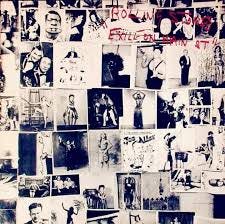
I am very much of the former faction and I will try to explain why in a moment. But first I think it’s incumbent that I should outline the conditions that gave rise to it, because that sometimes sketchy, occasionally meticulous but always aggressively articulated tangle of electro-acoustic sonorities and short reverb, explosive drums, shouts, drawls and whinnies, and some of the most powerful Gospel singing you will ever hear, did not grow out of barren pasture; nor was it entirely the product of a decadent summer of hard grind and lazy self-indulgence in a rented villa in the tiny resort of Villefranche-sur-Mer on the Mediterranean coast of France, as is usually how the story goes.
Exile was in fact put together in three different studios, two of them top-drawer facilities in London and Los Angeles, as well as the dank, airless basement of Villa Nellcote, where the group deployed the limited tech available in a mobile studio parked outside among the palm fronds in the outward form of a silver Airstream. Three different studios, but only one sound. Not much bass, few high frequencies; lots of middle with a slabby concrete feel to the music’s surface. Opaque. Voices half-buried in the mix, fighting for air. Impenetrable to the casually listening ear, but nothing like so impenetrable at the molecular level. And it is worth, I think, making the observation that the sound of the music cut at Olympic Studios in West London is not radically different to the Villefranche material. It’s almost as if by design, so close is it. It seems to me that, far from being a necessity born out of technical limitation, Exile was actually intended to sound like that. Tight and hard as a stone fist. I am certain it was not meant to be an easy ride.
I clicked with Exile when I was fifteen, some three years after the record’s release, and pretty much since that moment of ecstatic connection I have felt increasingly that its three marvellous predecessors, Sticky Fingers, Let It Bleed (1969) and Beggars Banquet (1968), can be viewed pretty much as the preliminary research for Exile on Main St; research conducted by the group’s musical director, Keith Richards, a musician now freed from the wounded and baleful stare of Brian Jones and a figure of almost complete authority in ‘his’ studio at his house, when not himself in an impenetrable stupor, and now sufficiently au fait with the functions of the knobs and faders of the modern studio to run the whole show as a co-production with established Stones producer Jimmy Miller. I can’t help but wonder whether the trip to Muscle Shoals Sound Studio in Alabama the previous year might have been conducted in that same spirit. A fact-finding mission. More research. I imagine that this is why Jagger has never been that keen on Exile: it is a record dominated by his songwriting partner almost to the point where it feels as if this were an authored Keith Richards project and the rest of the Stones were given houseroom and a long lunch in his crumbling villa so long as they were prepared to oblige as the guitarist’s sidemen, in all things, work, rest and play.
It is an extraordinary piece of work, Exile, and it really does not need the baggage of the Villa Nellcote narrative to make it connect. This is because, to me, the album represents the apogee of rock’s greatest inhering musical virtue as a musical form: its porosity. The way it lets other music into its veins and arteries, its shafts and cavities and even into its molecular structure. The way it allows for parody, pastiche and the fully integrated fusion of alien parts. The way it seems determined to make an aggressive stand against musical purism. And I love that. If Keith Richards and his mates had actually set out to demonstrate not only the porosity of rock but also how aesthetically valuable such a property might be, and how thrilling, then they could not have done a better job. I don’t think for a moment that that was their conscious objective though. They were just a bunch of English postwar skinnies, plus hangers on and servants, enjoying the dubious privileges of tax exile (Bill Wyman: “We had no choice, actually.”) and having a serious go at making coherent hay with the American music that thrilled them as boys and as younger men — and they do it to the extent that you simply cannot tell where the joins are.
Exile on Main St is a violently rocking demonstration (it is by no means an exegesis) of how rock, blues, country, soul, R&B, mento, folk, Gospel and Appalachian quickstep are all kin under the skin, if you ask the right kind of questions of each of them and of yourself. (Appalachian quickstep? I’m quite sure you’ll find it in there if you look hard enough.) You really cannot see where the stitching is, nor hear it, and only the occasional blaze of jubilant horns and the penumbral incantations of Venetta Fields, Clydie King, Joe Green, Tammi Lynn, Kathi MacDonald and Shirley Goodman serve to remind you that this is not entirely the product of suburban southern England in its urge to be different and alive in the world as it is, not as it was envisioned by the builders of the British Empire.
For it is music that only Englishmen can make — we have the perspective, you know, as well as the angle — and there is not a stroke of parody or pastiche to be found anywhere in it, except perhaps in the song that closes the piece, “Soul Survivor”. This is the Stones’ first little tinker with what came to be known in the critical orthodoxy of the ensuing years as ‘self-parody’.
FOR SURE, THEY did not distinguish themselves the following year with Goats Head Soup (1973), which comprised four good songs and six which would never have survived the first pass in the final mixdown for Exile. Goats Head was recorded in one of the more salubrious parts of Jamaica, which may account for the general torpidity which appears to have afflicted the sessions; torpidity and an apparent lack of interest in writing songs that express much at all, the exceptions being of course “Angie” plus “Starfucker”, the beautiful “Winter” and “Heartbreaker”, which just about squeezes itself on to the credit side of the ledger. It’s not a bad album so much as a rather limp and purposeless one.
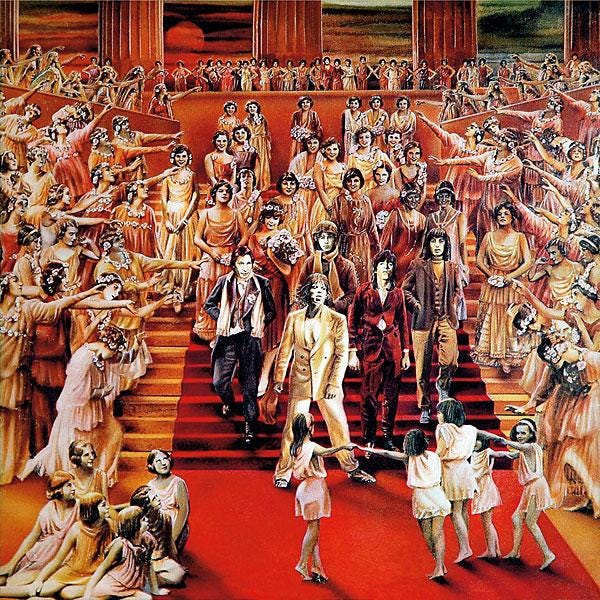
And then the following year It’s Only Rock and Roll (1974) stuck its unpretty mug over the parapet, an album which constituted the first official run-out of the sort-of-new Jagger / Richards Glimmer Twins production dog-of-two-heads: a suite of music of higher energy-output than its predecessor, and in most cases, better songs too, but a lot of stylistic pasticherie that many critics found irksome. Jagger hamming it up over the urbane funk smears of “Fingerprint File” was one; another was the plush Philly soul of “If You Really Want to Be My Friend”, in which the harmonious Blue Magic (who really did hail from Philadelphia) kept themselves at a safe distance while Mick got up on his toes to perform his own soulful circumrotations. The most intriguing pastiche on the album was not the spiky rock treatment of the Temptations’ “Ain’t Too Proud to Beg”, which was neither camp nor borderline racist, but an intriguing song entitled “Luxury”, which fell too close to the line for comfort. The song appears to be an aspirational ramble in the first person, perhaps scraped from the Stones’ Jamaican limo driver back when they were making Soup, which resolves into the tiniest critique of the global economic status quo. Jagger shapes one of his ethnic character studies, complete with accent and idiomatic phraseology, while the actual driver of the song, Richards, teases out of his thick guitar and Charlie’s rimshots a really rather gorgeous sway around the feels of Jamaican music, without actually falling into the trap of PLAYING REGGAE. You can dance to it and all. You wouldn’t want to sing along.
And perhaps inevitably It’s Only Rock and Roll was aggressively taken to task, often contradictorily, for two obvious failings: it had nothing to say with its proliferating stylistic pastiches and dodgy make-believe and neo-minstrelism. Nothing. And also, if you really wanted to, you could say it was a grievous case of self-parody. For such was the tenor of the times. How do you do a “Gimme Shelter” or a “Street Fighting Man” for the Noel Edmonds-y early/mid-1970s?
Me, I liked “Fingerprint File” and “Luxury” and couldn’t get enough of the title track, in which other people pretended to be the Rolling Stones and succeeded, a pissed David Bowie rumoured to be among them.
AND THEN MICK TAYLOR, the lyric lead guitarist, left the band at Christmas 1974 just after It’s Only Rock and Roll came out and the Stones had to find a new one in a jiffy.
But no jiffies were to hand and the speculation became one of the music press sagas of 1975. Who would it be? Chris Spedding? Jeff Beck? Eric Clapton? Ron Wood? Peter Frampton? Earl Slick? Mick Ronson? John Meredith? It got so that if you could hold an electric guitar the right way up and didn’t look like a turnip, you were in with a chance. It was really tedious. Well, I thought so and I wasn’t even fifteen yet.
Meanwhile there were stirrings among the rhododendrons outside. Stirrings and scuffles and strangely belligerent snorts. Most established rock acts remained utterly oblivious of the threat among the pom-poms. The scowling young people. The growing sense of contempt, which you might nose in every bunker and bus shelter twixt here and the suburbs. And the Rolling Stones? What did they do in their lofty citadel?
They made an album almost entirely confected from either parodies or pastiches of the music they had internalised along the high road to superstardom, from high adolescence to the foothills of adulthood. They were now encamped in their early thirties and they had debts to discharge, as well as a new guitarist to find. They went into the same studio in Germany as they had for It’s Only Rock and Roll and emerged from it a while afterwards with eight songs, three extra guitar players and the best-recorded music they had ever made. Black and Blue had its equivalences with Exile on Main St, but for the most part it was its diametric opposite, in both conception and execution.
Black and Blue is in very many ways a good record. If it was your entry point to the world of the Rolling Stones then you might well react like Marie-Claude Bertillon sur le magnétophone in Frog lessons at school. Marie-Claude, a pop culture maven at the age of fifteen, would clasp her hands under her pointy chin and gasp, “Oh chic alors! J’adore les Rrrrolling Stones!”
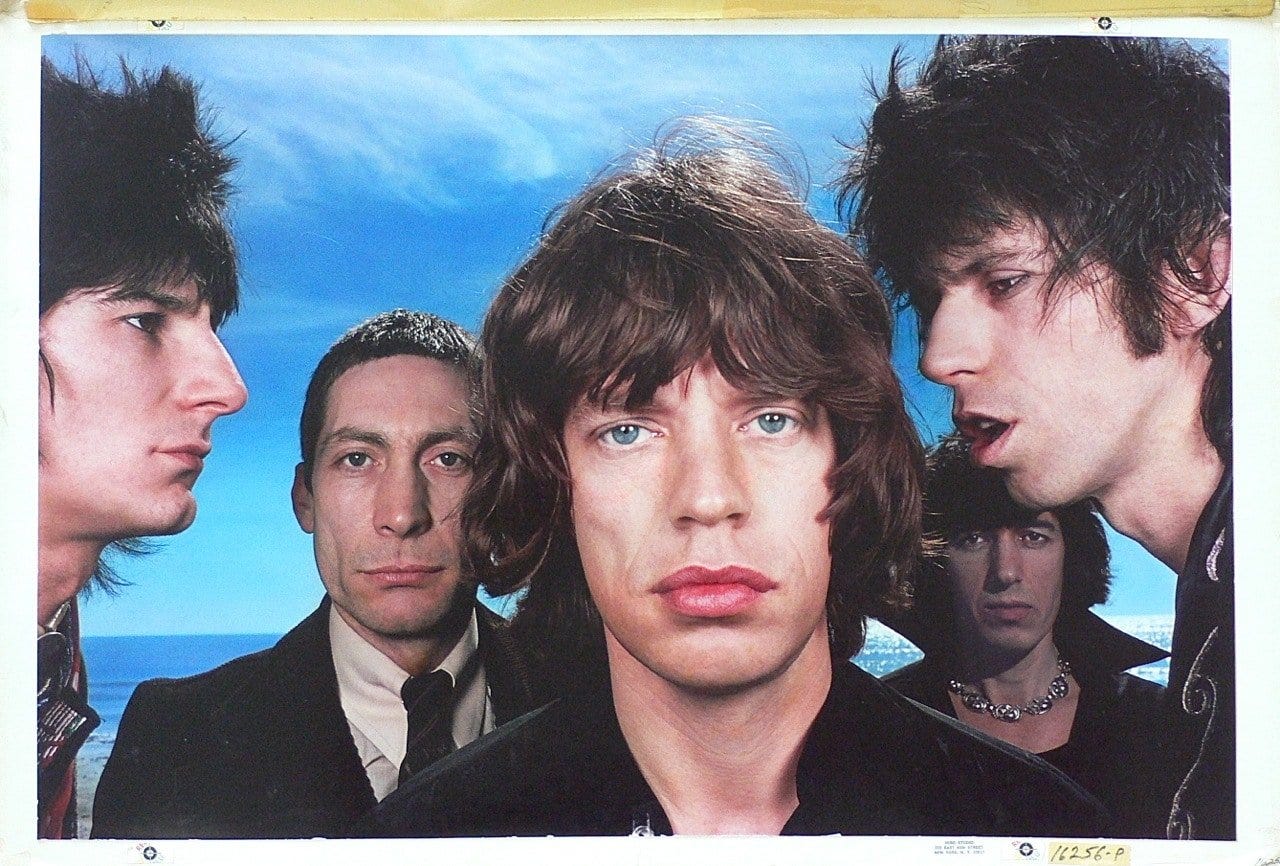
Black and Blue is absolutely chic in a manner that Marie-Claude would certainly get. It is stylish. It demonstrates a certain curiosity about the world it is contained by, and recognises that everything within that world is an object in a relationship with the objects that are not only proximate to it but also inside it, including, bien sur, les Rrrrolling Stones themselves, who are, startlingly, closer than ever to you, if you read the cover image correctly — for heaven’s sake, you can see the open pores on their hideous faces! The music is sheened with sophistication; the cover photography is chic-ly hyper-realistic, hyper-lit on a beach at dusk. It cost a hyper-priced bomb to buy too during an era when record companies would occasionally set special retail prices for special records (my memory says that I paid the enormous sum of £3.99 for my copy, which was an extra-special amount of dosh to me). As far as object relations go, B&B was one of the Stones’ last things that, when dropped into the middle of pop culture’s spreading puddle, sent out a ripple.
But how was it as music?
Mostly it got booted from pillar to post in the UK music press. Some reviewers tried to be patient and not give way to infantile hyperbole, but by the onset of “Crazy Mama” at the close of side two, the infantile wail of “self-parody” was by and large all that could be heard. And the three guitarists? They acquitted themselves rather well, especially, I thought, the one called Harvey Mandel. The One Called Wayne Perkins was pretty smooth and licky on his featured song too — closer to the lost and lyrical Mick Taylor in style. But Ron Wood had obviously won the game, because he was on the cover on the beach à l’heure du crèpuscule, his amiable beaky profile trying not to look smug.
The music, though, the music…
It was sometimes very good, sometimes not. And one song in particular revealed in every aching muscle and twitch-fibre of its considerable length that the Rolling Stones are best when they convey themselves, with great seriousness of intent, past the cupboard marked “Heh-heh-heh-heh”, where all the kit for making parodies and pastiches is kept, and move on swiftly down the corridor to the place where they left off with Exile On Main St, just before “Soul Survivor” at the end of side four. That was a song called “Shine a Light”. It was a sort of howled Gospel ululation, entirely written by Mick Jagger without the involvement of Keith Richards (who does not appear on it at all), in which the singer tries to air with unusual sincerity some of what we might take for his complicated feelings about Brian Jones, the Banquo at the feast of Exile on Main St. This new song, “Memory Motel”, is not as good as “Shine a Light” (or indeed as “Moonlight Mile”, Jagger’s sans-Richards ballad on Sticky Fingers), or as subjectively revealing, but is of that order of quality and tenderness. My memory of “Memory Motel” is that it moved my sixteen year-old soul to a place it was unaccustomed to being, where you simply could not see the joins nor any stitching. I wish with all my heart that I could go there now.
The rest is nowhere near silence.
“Hot Stuff”, which doesn’t so much kick off proceedings as snit them off, is very much of a piece with every other white rock band in the world that year, as 1975 drew to a close. The piece was entitled “I wanna get the funk”. They did, you know, they really did. It was a rule that year. But the Stones did it better than most, partly thanks to the Ohio Players, whose vibe and carriage they co-opted whole, lock, stock and bump. The One Called Harvey Mandel’s squonky backwards cry-baby guitar descant should have sealed the gig for him as the Stones’ new lead guitar, in my view, but perhaps he smoked the wrong brand of fags, or maybe he didn’t smoke at all. Or he looked like a root vegetable. Interesting musicological note: somehow the rhythm section contrive by the end to land the big wallop on the four, instead of the one, where they all started. This is possibly a testament to their technical genius or, more likely, that dear old Charlie Watts really didn’t have the fonk.
“Hand of Fate”, featuring The One Called Wayne Perkins, comes out swinging in boiler-plate Rolling Stones style and moves comfortably from one end of the intestine to the other with a smooth effort-free series of tractions that would make someone a pretty pile were they to find a way to market “Hand of Fate” in tablet form. I realise this sounds as if I mean to be rude. I don’t. It is a satisfying piece of music.
Which brings us to the one certified stinker on the record, a simply awful, full-blown pastiche of Eric Donaldson’s reggae minor-classic “Cherry, Oh Baby”, in which Charlie Watts demonstrates he doesn’t fancy reggae either. And someone should retrieve the veil that was drawn in 1976 over Mick Jagger’s gargling of the lyric in some weird Barbary-piratical accent of the 17th century, and gag him with it.
Ron Wood’s “Hey Negrita” is another failure, in my view — though it doesn’t smell as badly as the reggae song. It’s a lurching, jittering faintly Latin riff-motif played by the estimable bargee, around which the rest of the group gather mystified and scratching their pates. Horrid “lyrics”, ghastly singing. The vibe of the whole enterprise seems to be, “Nah, nor me, mate!”
Then Billy Preston takes over for a slight but fun six minutes or so, called “Melody”, a bar-room swinger which is entertaining enough and does at least afford Charlie the opportunity to be Number One Charlie for a while. You can almost hear his teeth exposing themselves with joy. Mick and Billy get off on each other. Eventually it reaches a comfortable end and everyone promptly forgets that it ever existed — except for Mick who rather likes the way he sings this one and fights to keep it on the finished record in the face of Keith’s scornful moué.
There is, however, one other really fine song on Black and Blue. It’s the one you don’t have to be a slavering Stones fan to recognise and even quite like. It’s called “Fool To Cry” and it has a genuinely touching feel to its cradling cadences and Jagger’s strangely authentic performance of a lyric in which a broken father looks to the consoling words of his small daughter. All very Gilbert O’Sullivan, I hear you cry. Yes, well. Except that Gilbert O’Sullivan was not capable of Jagger’s soulful reach and presence, nor did his arrangements captivate like this, prim and negligent as they were, and grounded in the deeply naff realm of 1970s British studio pop.
One other thing… There’s a passing phrase in the breakdown that serves as a coda at the end, before “Fool To Cry”’s pleasingly formal, even stately closure, which I presume was the work of Keith Richards. It’s a brief, sliding chromatic upshift in the guitar part, right at the tail of the chord sequence, which I used to get in my palpitating heart as something respiratory to do with the cessation of tears. Richards plays it with more conviction as each repeated passage grows through its final circulating cadences. It is only two bars long and just a small movement in the music. But when it was first a hit I would wait breathless for its arrival, as one does for a girl one thinks one loves as she really ought to be coming round the corner any second now, and she’s already six minutes late.
The album closes with “Crazy Mama”, which is not self-parody. It’s a lazy bit of fun, which is not quite the same thing. It must have been fun to do at least, mustn’t it?
AND THERE IT IS: Black and Blue, which is to be re-issued in newly remixed form by the ubiquitous Stephen Wilson some time in the middle of November. Not a great album but by no means a bad one either, not by the standards that the Rolling Stones would come to plumb in the following couple of decades.
Black and Blue, furthermore, which can claim to be endowed with the highest incidence of outright pastiche and parody (as well as guitarists) of any record the Stones ever made — yet not the one you need if you are to appease the authority demanding your considered view of what constitutes the difference between the two old devils, P and P. You need Sticky Fingers and Some Girls for that. The songs you want are “Faraway Eyes” and “Dead Flowers”.
I’ll leave you to decide which is which.
Nick Coleman is the author of three books which take music as their environment: ‘The Train in the Night: a Story of Music and Loss’, ‘Voices: how a great singer can change your life’ and ‘Pillow Man’, a novel — all three are published by Vintage / Jonathan Cape in the UK and by Counterpoint in the US. A fourth book, ‘Dreaming Music: Adventures in Time, Memory and Silence’, is to be published by Vine Leaves Press
I had the luck of seeing them live twice. One time in Rio de Janeiro in 2000 I think, Dylan opened the show. The second time was last year in New Orleans Jazz Fest. In both occasions they were playing in a remarkable small venue due to extraordinary reasons. And if you ever seen them live, you know that that the energy of the show is everything. Is unspeakable, you just have to be there to experience. Two hours pass like 20 min…
Exile and Sticky are my all-time favorites.